The joint US-Israel military attacks on Iran that were launched on Friday are illegal under international law, and are an unjustifiable approach to addressing concerns relating to civil rights violations and Iran's military developments.
The US has alleged that Iran had restarted its nuclear program, had enough available nuclear material to build a bomb within days and was developing long-range missiles that could soon be capable of hitting the United States. The New York Times has reported that all three of these claims are false. (See also Illegal U.S.-Israel Attacks Not Justifiable on Nonproliferation Grounds, Arms Control Association).
However, even if the allegations were true, this would not provide legal or political justification to launch military attacks against Iran. The UN Charter prohibits the threat or use of force in international relations, except in self defense in response to a military attack, and requires Member States to resolve their disputes through peaceful means.
Iran has been participating in negotiations with the United States on issues regarding their missiles and nuclear energy facilities. At the most recent session, which was just two days prior to the US-Israel attack on Iran, both parties indicated that a negotiated solution was still possible. And even if such negotiations ultimately failed, the UN Charter provides many other approaches and mechanisms that can and should be used to resolve inter-State disputes peacefully.
In addition, Iran supports, and has been participating in, the ongoing UN Conference on establishing a Middle-East Zone free from Nuclear Weapons and other Weapons of Mass Destruction. Israel and the United States, on the other hand, do not support the UN conference. The reason for their opposition is that the adoption of a Middle East NWFZ agreement would mean that all states in the region, including Israel, would be prohibited from possessing nuclear weapons and other WMD.
Allegations that the Iranian government has been violating the civil and human rights of its citizens have much more credibility and are indeed cause for concern. Amnesty International has reported that "Iran has a long-documented record of severe civil rights violations, involving the violent suppression of dissent, systematic discrimination against women and minorities, and the use of torture, arbitrary detention, and forced disappearances. As of early 2026, the state has continued crackdowns on protesters, including massacres of dissidents."
Under the Responsibility to Protect doctrine, the international community has a responsibility to respond to serious violations of human rights, including atrocity crimes. However, the UN also has mechanisms to address civil rights violations in countries, including through the Human Rights Council, International Court of Justice and UN Security Council. Iran is answerable to both treaty law (such as the International Covenant on Civil and Political Rights which Iran has ratified) and international customary law. Obligations under this law can generally be monitored and enforced through these UN bodies. The use of force against a State in response to serious civil rights violations can only be used as a last resort when all peaceful, non-coercive measures have failed, and must be approved by the UN Security Council under Chapter VII of the UN Charter. These requirements have not been met in the US-Israel attack against Iran.
A number of the recommendations in A Nobel Effort: Opportunities for Switzerland to advance peace and nuclear disarmament in 2026, are applicable to the dispute between US-Israel and Iran, including:
- Recommendation 4, promoting universal acceptance of the compulsory jurisdiction of the International Court of Justice for the peaceful resolution of inter-State disputes (Iran accepts ICJ jurisdiction - with some caveats - while US and Israel do not).
- Recommendation 6, on improving the jurisdiction of the International Criminal Court over the crime of aggression;
- Recommendation 8, on supporting the deliberations to establish a Middle East Zone Free from Nuclear Weapons and Other Weapons of Mass Destruction.
- Recommendation 16, on engaging in the Universal Periodic Reviews of States obligations under human rights law with respect to their nuclear weapons programs.
A draft of A Nobel Effort was released for discussion at the Basel Intergenerational Forum Reversing the Doomsday Clock on January 23, 2026. It will be discussed further at A Nobel Effort: Preventing aggression and advancing nuclear disarmament in 2026, an event in the Swiss parliament on March 3.
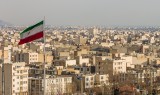
Cover Photo: Tehran skyline. Photo Emanuele Mazzoni 123RF